
Why Asia Pacific Is Becoming a Global Hub for Lithium-ion Battery Recycling
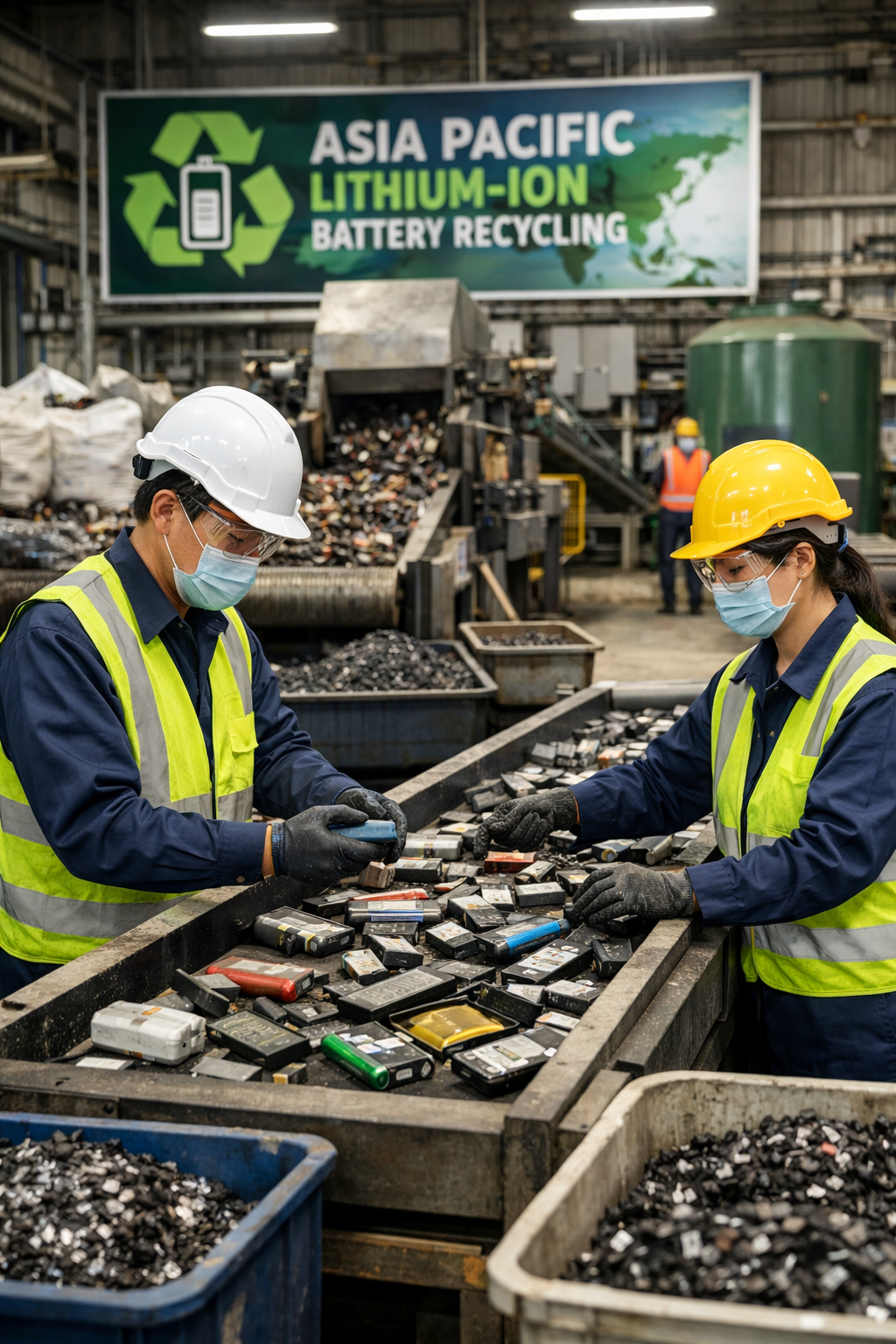
The Asia Pacific lithium-ion battery recycling market is projected to grow from USD 9.71 billion in 2025 to USD 34.44 billion by 2032, at a CAGR of 19.8% during the forecast period. Rapid growth of electric vehicles, consumer electronics, and stationary storage systems across China, Japan, South Korea, India, and Southeast Asia is generating a surge in end‑of‑life batteries, which is boosting the need for recycling in Asia Pacific. At the same time, governments are implementing stringent environmental regulations and introducing extended producer responsibility schemes, which mandate collection and recycling.
Based on battery chemistry, the lithium iron phosphate segment is expected to register the highest CAGR during the forecast period.
The LFP (Lithium Iron Phosphate) segment is emerging as the fastest-growing battery chemistry in the Asia Pacific region, driven by rapid adoption across key sectors. The demand for LFP batteries in electric vehicles, energy storage systems, and industrial machinery is growing fast with the support of the strong manufacturing ecosystems in countries such as China and South Korea. The advantages that LFP batteries possess, such as high safety, long cycle life, and low production costs, are making them more attractive to manufacturers and end users in the region. Their widespread use in large energy storage systems, especially in renewable energy integration and grid stabilization projects, has made them even more popular. As the demand for LFP batteries increases in the Asia Pacific region, there will be a corresponding increase in the amount of dead LFP batteries, which will create a huge requirement for efficient lithium recovery and recycling processes.
Download PDF Brochure: https://www.marketsandmarkets.com/pdfdownloadNew.asp?id=167614952
Based on source, the non-automotive segment is expected to register the highest CAGR during the forecast period.
The growing requirement for consumer electronics, power tools, marine devices, and industrial machines is fueling demand for lithium-ion batteries. This is leading to a higher amount of end-of-life batteries. Also, the fast-moving renewable energy projects in the Asia Pacific region are increasing the demand for lithium-ion batteries. These batteries are increasingly used for grid balancing, energy storage systems, and backup power applications, among others. The increasing lithium-ion battery usage in diverse non-automotive applications and their continued integration into everyday operations and industrial processes are also major factors driving the market growth. Moreover, the marine, logistics, and manufacturing sectors are moving towards electrification, which entails a significant increase in battery deployment and future recycling requirements. These factors are creating a substantial increase in spent lithium-ion batteries in Asia Pacific.
Australia is projected to be the fastest-growing market during the forecast period.
Australia is expected to register the highest growth in the Asia Pacific lithium-ion battery recycling market. There is a significant growth in lithium-ion battery recycling in the country due to high EV adoption rates, an increase in energy storage installations, and demand for consumer electronics. One of the reasons for this rapid change in Australia is the enforcement of strict waste management and stewardship policies, such as the B-cycle battery recycling scheme, which is significantly improving the collection rates of discarded Li-ion batteries. The local recycling capability in Australia is reinforced by increasing investments from both domestic companies and new recyclers. Due to the rapid installation of renewable energy storage projects and the shift towards a circular economy, the quantity of end-of-life lithium-ion batteries is predicted to increase rapidly. Consequently, the need for effective material recovery processes, especially for lithium, cobalt, and nickel, is growing faster, making Australia an important player in the lithium-ion battery recycling market in the Asia Pacific region.
Contemporary Amperex Technology Co., Limited (CATL) (China), GEM Co., Ltd. (China), Attero Recycling (India), Umicore (Belgium), and SK Tes (Singapore) fall under the winners' category. These are leading players in the Asia Pacific lithium-ion battery recycling market according to their revenue, production capacity, technological innovation, and market presence.
Get a Sample Copy of This Report: https://www.marketsandmarkets.com/requestsampleNew.asp?id=167614952
Contemporary Amperex Technology Co., Limited (CATL) (China)
Contemporary Amperex Technology Co., Limited (CATL) is focused on innovative energy technologies. It is listed on the Shenzhen Stock Exchange. CATL offers its services through a solution-based portfolio that includes passenger vehicles, commercial applications, energy storage systems, and battery recycling. The company engages in lithium-ion battery recycling through its subsidiary, Guangdong Brunp Recycling Technology (China).
Guangdong Brunp Recycling Technology, formerly Foshan Brunp Recycling Science and Technology Co., Ltd., was established in 2005. It operates the entire battery industrial chain recycling system and recovers nickel, cobalt, manganese, and lithium from spent digital batteries and auto power batteries. Its waste battery disposal capacity is around 120,000 tons per annum and generates nickel manganese cobalt hydroxides (Ternary precursor), nickel manganese acid lithium cobalt (Ternary material), lithium cobalt oxide, cobalt chloride, nickel sulfate, cobaltous sulfate, and cobaltosic oxide, with a total yield of more than 99%. Its battery recycling network covers China, Japan, South Korea, Taiwan, and the Americas. CATL operates its subsidiaries in France, the US, Canada, and Japan, among other countries. It has approximately 13 manufacturing facilities in China, Hungary, and Germany, along with 5 R&D centers in China and Munich (Germany).
GEM Co., Ltd. (China)
GEM Co., Ltd. is among the leading companies operating in the new energy material and cemented carbide material industries. It recycles rare metal resources, battery packs, electronic waste, and used cars. Lithium-ion battery recycling services are offered under its power battery recycling business. The company has established seven end-of-life vehicle recycling centers, six e-waste green processing centers, five waste power battery comprehensive utilization centers, four battery material manufacturing centers, three waste plastic recycling centers, two solid waste treatment centers, and one nickel-cobalt-tungsten resource recycling center for recycling lithium-ion batteries. These facilities aid in recovering metals such as lithium, nickel, cobalt, manganese, copper, aluminum, and other components from used batteries. Generally, these valuable metals are reused to produce new battery materials to serve customers such as Samsung SDI, Toyota, EVE, Volkswagen, and others. With its green dismantling lines, the company handles more than 250,000 tons of waste power battery packs annually.
The company operates in Europe, the US, South Korea, and Indonesia. GEM Co., Ltd. has also established new energy materials facilities and 16 waste recycling parks in 11 provinces and municipalities of China, including Hubei, Hunan, Guangdong, Jiangxi, Henan, Tianjin, Jiangsu, Zhejiang, Shanxi, Inner Mongolia, and Fujian.
Attero Recycling (India)
Attero is an electronic asset management company specializing in end-to-end e-waste recycling solutions. Attero offers services to customers and businesses through its core business activities: E-waste recycling, reverse logistics, client compliance & consulting, and lithium-ion battery recycling. The company has a strong presence in countries such as South Korea, Australia, India, and Hungary.
SK Tes (Singapore)
TES, a wholly owned subsidiary of SK, provides synchronized electronic waste management solutions. Its services include energy storage solutions, onsite data destruction, battery recycling, IT asset disposition, and data center services. The company employs two different battery recycling processes: black mass process and chemical refinement process, to recover lithium-ion batteries. Both are hydrometallurgical-based processes offering more than 99% pure elements with a 90% recovery rate. The extracted components include lithium carbonate, cobalt hydroxide, nickel, graphite, copper, aluminum, and sodium sulfate (by-product). Its commercial battery recycling facility in Singapore has the capacity to process more than 14 tons of lithium-ion batteries or the equivalent of 280,000 smartphones each day. The company's clients range from OEMs, CEMs, repair and servicing companies to logistics providers, electronic waste brokers, local authorities, and national environmental agencies. Its operating sites are located across Asia Pacific, Europe, and North America.
Umicore (Belgium)
Umicore is a materials technology company and recycling group in chemistry, material science, and metallurgy, with operations across Europe, North America, South America, Asia Pacific, and Africa. It operates through three business segments, namely recycling, catalysis, and energy & surface technologies. The recycling segment comprises battery recycling solutions, jewelry & industrial metals, precious metals management, and precious metals refining. Umicore serves various industries, including energy, automotive, recycling, chemicals, manufacturing, optics & displays, precious metals, and electronics. It operates a recycling facility in Hoboken (Belgium). Also, the company recycles batteries through its recycling plant in Hanau (Germany). Both facilities employ hydrometallurgy and pyrometallurgy recycling processes for recycling batteries.

 English
 Arabic
 French
 Spanish
 Deutsch
 Turkish
 Dutch
Dutch
 Italiano
 Russian
 Romaian
 Portuguese (Brazil)
 Greek
Greek