


Flooring Market Growth Overview, Facts & Figures, Segmentation, Future Trends, and Historical Analysis
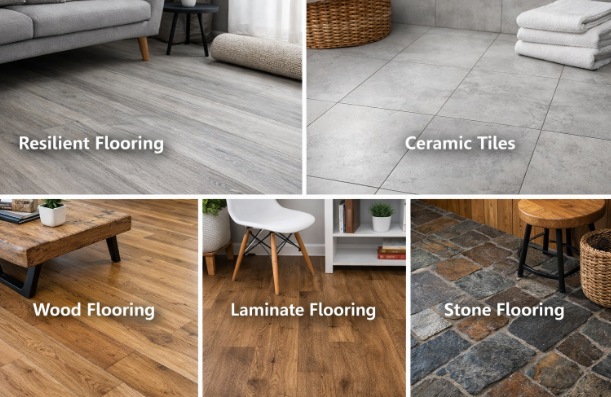
The report "Flooring Market by Material (Resilient, Non-Resilient (Ceramic tiles, Wood, Laminate, Stone), Soft-floor covering), End-use Industry (Residential, Non-residential), & Region (North America, Europe , APAC, MEA, South America) - Global Forecast to 2028", The market for flooring is approximated to be USD 331.9 billion in 2023, and it is projected to reach USD 510.7 billion by 2028, at a CAGR of 9.0%. Increasing population and rapid urbanization, increasing investments in the construction sector, and rising number of renovation and remodeling activities are key drivers promoting the market growth. The volatile raw material prices is a major restraint in the flooring market as it affects the overall pricing of the product. A rapidly progressing organized retail sector is a major opportunity in the flooring market. The flooring industry also faces the challenge of extreme competition in the market.
Browse in-depth TOC on "Flooring Market"
146 – Tables
36 – Figures
200 – Pages
Download PDF Brochure: https://www.marketsandmarkets.com/pdfdownloadNew.asp?id=110789434
Flooring Market Dynamics
Driver: Rise in population & rapid urbanization and increase in investment in the construction industry are the major drivers of the flooring market.
As the population grows, the demand for housing also rises. This creates a need for flooring materials in residential construction projects. Whether it's new housing developments or renovations, the flooring market benefits from the increased demand for various types of flooring products. Urbanization leads to the construction of roads, bridges, airports, railway stations, and public spaces, all of which require flooring materials. The flooring market benefits from this increased construction activity in urban areas.
Restraint: Volatile raw material prices
Raw material price fluctuations can be a considerable restraint for the flooring industry, affecting the profitability and competitiveness of flooring companies. Fluctuations in raw material prices directly impact the cost of producing flooring products. If the prices of key raw materials, such as wood, vinyl, carpet fibers, ceramics, or resins, increase, manufacturers may face higher production costs. This can lead to increased prices for finished flooring products, affecting consumer demand and market competitiveness.
Opportunities: Rise in demand from emerging economies
Emerging economies present significant opportunities for the flooring industry due to rapid urbanization, a growing middle class, infrastructure development, renovation and modernization needs, rising consumer awareness, and the growing tourism and hospitality industry. These factors drive the demand for flooring materials and offer a favourable market environment for manufacturers and suppliers. By leveraging these opportunities, flooring businesses can establish a strong presence and drive growth in emerging markets.
Challenges: Disposal of waste
The flooring industry generates a significant volume of waste during installation, renovation, and demolition processes. This waste includes old flooring materials, scraps, packaging, adhesives, and other related items. Disposing of such large volumes of waste can be costly and time-consuming. Some flooring materials, such as certain adhesives, coatings, or underlays, may contain hazardous substances. Disposing of these materials requires adherence to specific regulations and guidelines to ensure proper handling, containment, and disposal to avoid environmental and health risks.
Request Sample Pages: https://www.marketsandmarkets.com/requestsampleNew.asp?id=110789434
Flooring Market Segmentation
Flooring Market by Material
- Resilient Flooring
- Vinyl
- Others
- Non-Resilient Flooring
- Ceramic tiles
- Wood
- Laminate
- Stone
- Others
- Soft floor covering/ Carpets & Rugs
Flooring Market by End-use industry
- Non-residential
- Residential
Flooring Market by Region
- North America
- Europe
- Asia Pacific (APAC)
- Middle East & Africa
- South America
By material, non-resilient segment accounted for the largest share in 2022
Resilient flooring possesses a specific characteristic i.e., when given a slight press on it, it quickly springs back into place. This provides greater grip, and a decreased chance of slip-and-fall incidents. The term non-resilient flooring refers to solid flooring which is not flexible. Terrazzo, marble, stone, ceramic tile, and concrete all fall under the category of non-resilient flooring. In general, non-resilient flooring can outlive resilient flooring and are more durable. In areas with heavy foot traffic, non-resilient flooring is frequently used by architects and designers. In general, non-resilient floors require less upkeep and maintenance than resilient ones. Owing to these properties the non -resilient segment dominated the market.
Speak to Expert: https://www.marketsandmarkets.com/speaktoanalystNew.asp?id=110789434
By End-Use Industry, the Non-Residential Segment accounted for the second largest share in 2022.
In the non-residential end use industry segment the demand for flooring is expected to be driven by increasing spending on office spaces and other commercial & institutional constructions where flooring is used extensively. These buildings can be classified as commercial, institutional & healthcare, and public facilities. The commercial and institutional spaces like malls, hospitals, colleges, schools, gyms are subjected to heavy foot traffic and heavy furniture loads. Hnece the flooring durability and aesthetic aspect both are important factors when choosing a suitable flooring material.
Europe accounted for the second largest market share of the Flooring Market in 2022
The rising demand of housing in urban areas, increased infrastructure development activities, and increased modernization and renovation of buildings are the major key factors for the expansion of the European construction market. With the region's robust economic growth, commercial infrastructure construction, such as offices, schools, hotels, restaurants, and leisure facilities, is on the rise. Initiatives and investments by the government are aiding the growth of the European infrastructure.
The key players profiled in the Flooring Market report are Mohawk Industries, Inc. (US), Tarkett (France), Forbo (Switzerland), Shaw Industries Group Inc. (Georgia), Interface, Inc. (US), and others.
Mohawk Industries, Inc. engages in the manufacture, design, and distribution of residential and commercial flooring products. It operates through the following segments: Global Ceramic, Flooring North America (NA), and Flooring Rest of the World (ROW). The Global Ceramic segment manufactures ceramic, porcelain, and natural stone tile products used for wall and floor applications.
Tarkett is among the leading flooring companies that offer a wide range of flooring solutions to commercial and residential end users. For 140 years, dedication to excellence, innovation, coupled with a long lasting commitment to sustainability, have contributed to the leading position of Tarkett in sports surfaces and cutting-edge flooring solutions. The company has a wide presence across all regions such as North America, South America, Europe, Asia Pacific, and the Middle East & Africa, with 34 industrial sites across the world.
Forbo is a global manufacturer and trader of floorings, adhesives, and conveyor technology. The company has two business segments i.e., Flooring Systems and Movement Systems. The Flooring Systems division includes commercial and residential floor coverings and segments. The Flooring Systems segment develops, produces, and sells linoleum, vinyl floorings, entrance flooring systems, carpet tiles; needle felt floor coverings, Flotex, the washable textile flooring, and building and construction adhesives.
Request New Version: https://www.marketsandmarkets.com/RequestNewVersion.asp?id=110789434
Table of Contents
Chapter 1: Introduction
Chapter 2: Executive Summary
Chapter 3: Growth Opportunities by Segment
Chapter 4: Market Landscape
Chapter 5: Flooring Market by Material
Chapter 6: Flooring Market by End Use Industry
Chapter 7: Company Profiles & Competitive Analysis
Chapter 8: Global Flooring Insights & Forecast
Chapter 9: North America Market Forecast
Chapter 10: Europe Market Forecast
Chapter 11: Asia-Pacific Market Forecast
Chapter 12: Middle East & Africa Market Forecast

 English
 Arabic
 French
 Portuguese
 Deutsch
 Turkish
 Dutch
Dutch
 Italiano
 Russian
 Romaian
 Portuguese (Brazil)
 Greek
Greek