


Stem Cell Banking Market Size to Reach USD 21.5 Billion by 2032
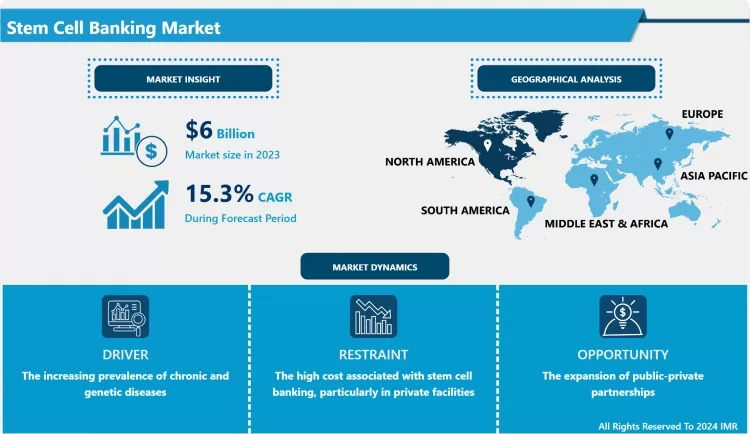
According to a new report published by Introspective Market Research, Stem Cell Banking Market by Service Type, Source, Bank Type, and Region, The Global Stem Cell Banking Market Size Was Valued at USD 6.0 Billion in 2023 and is Projected to Reach USD 21.5 Billion by 2032, Growing at a CAGR of 15.3%.
Overview:
The global stem cell banking market is a specialized segment of the life sciences industry focused on the collection, processing, cryopreservation, and storage of stem cells for potential future therapeutic use. This market primarily revolves around banking stem cells derived from umbilical cord blood and tissue, placental tissue, and dental pulp. The core advantage of stem cell banking over relying on donor registries is the provision of a perfect genetic match for the donor (autologous use) or a closely matched sample for family members (allogeneic use), significantly reducing the risk of transplant rejection. These biologically unique cells offer a form of "biological insurance" for treating a range of conditions.
Stem cell banks are critical facilitators of regenerative medicine and advanced cellular therapies. Their primary use is in clinical applications for hematopoietic stem cell transplantation (HSCT) to treat blood cancers like leukemia, lymphoma, and inherited blood disorders. Furthermore, the expanding field of regenerative medicine is exploring the use of banked mesenchymal stem cells (MSCs) from cord tissue for potential therapies in neurological conditions, autoimmune diseases, and tissue repair. The market serves expectant families, medical researchers, and healthcare providers, positioning itself at the intersection of preventative healthcare, medical innovation, and personalized treatment.
Growth Driver:
The paramount growth driver for the stem cell banking market is the rapid expansion of clinical applications and approvals for stem cell-based therapies within regenerative medicine. Beyond the well-established use of cord blood stem cells for treating blood disorders, significant research and clinical trials are demonstrating the therapeutic potential of mesenchymal stem cells (MSCs) from cord tissue and other sources for conditions like cerebral palsy, autism spectrum disorder, type 1 diabetes, and cartilage repair. As these therapies move from experimental to approved treatments, the perceived future utility and value of banked stem cells increase dramatically. This expanding clinical validation directly fuels demand from expectant parents seeking to preserve these cells as a potential therapeutic resource for their child and family.
Market Opportunity:
A significant market opportunity lies in the development of advanced, value-added services and the expansion into emerging therapeutic areas. Beyond basic storage, banks can offer advanced cell characterization, potency testing, and expansion services to prepare "therapy-ready" doses. Furthermore, the exploration of induced pluripotent stem cell (iPSC) banking—creating personalized stem cell lines from a simple blood sample—represents a revolutionary frontier for adult banking and disease modeling. Collaborations with biopharma companies to supply high-quality, characterized stem cells for drug discovery and clinical trials also present a lucrative B2B revenue stream. Companies that innovate beyond commoditized storage to become integrated partners in the cellular therapy supply chain will capture a leading market position.
Stem Cell Banking Market, Segmentation
The Stem Cell Banking Market is segmented on the basis of Service Type, Source, and Bank Type.
Source
The Source segment is further classified into Cord Blood, Cord Tissue, Placental Tissue, and Dental Pulp. Among these, the Cord Blood sub-segment accounted for the highest market share in 2023. Cord blood dominates due to its long-established clinical history in hematopoietic stem cell transplantation for over 80 diseases, standardized collection and processing protocols, and strong regulatory framework. It is the most widely marketed and recognized stem cell source among consumers, with thousands of successful transplants performed globally, solidifying its position as the market's foundation.
Bank Type
The Bank Type segment is further classified into Public and Private/Family Banks. Among these, the Private/Family Banks sub-segment accounted for the highest market share in 2023. Private banks dominate the revenue landscape as they charge families for collection, processing, and long-term storage, creating a direct-to-consumer business model. The strong marketing focus on "biological insurance" for the family's future health, coupled with the perceived limitations of public bank accessibility, drives significant consumer investment in private banking services, especially in regions with high healthcare expenditure.
Some of The Leading/Active Market Players Are-
• Cordlife Group Limited (Singapore)
• Cryo-Cell International, Inc. (US)
• ViaCord (A PerkinElmer Company) (US)
• CBR Systems, Inc. (A CooperSurgical Company) (US)
• LifeCell International Pvt. Ltd. (India)
• StemCyte India Therapeutics Pvt. Ltd. (India)
• Global Cord Blood Corporation (China)
• Smart Cells International Ltd. (UK)
• CryoHoldco (Latin America)
• Vita 34 AG (Germany)
• Cells4Life Group LLP (UK)
• Esperite N.V. (Netherlands)
• ReeLabs Pvt. Ltd. (India)
• Cryo-Save AG (A Nectar Lifesciences Ltd. Company) (India)
• “and other active players.”
Key Industry Developments
News 1:
In April 2024, Cryo-Cell International announced a strategic partnership with a leading regenerative medicine research institute to co-develop clinical-grade, expanded mesenchymal stem cell (MSC) products from banked cord tissue.
The collaboration aims to translate banked samples into standardized, off-the-shelf therapeutic doses for clinical trials in autoimmune and orthopedic conditions.
News 2:
In March 2024, LifeCell International launched "CellAdvantage," a new service combining the banking of cord blood, cord tissue, and placental tissue with optional long-term cell viability and potency testing reports.
The bundled service is designed to maximize the future therapeutic utility of banked samples and provide families with ongoing quality assurance data.
Key Findings of the Study
• Cord Blood is the dominant source, and Private/Family Banks lead the market by bank type.
• North America holds the largest market share, driven by high awareness, disposable income, and advanced healthcare infrastructure.
• Increasing clinical applications and approvals for stem cell-based therapies are the primary market growth drivers.
• Key trends include the banking of multiple tissue sources, technological advancements in cryopreservation, and growing partnerships with therapeutic developers.

 English
 Arabic
 French
 Portuguese
 Deutsch
 Turkish
 Dutch
Dutch
 Italiano
 Russian
 Romaian
 Portuguese (Brazil)
 Greek
Greek